Введение
Микробиом – комплексная система человеческого организма, представляющая собой совокупность бактерий, архей, простейших, грибов и вирусов. Вышеуказанные таксоны обеспечивают регуляцию тканевого метаболизма во влагалище и поддержание целостности эпителия слизистой оболочки кишечника, а в случае нарушения баланса в микроэкосистеме повышается риск развития воспалительных заболеваний [1–3]. Влагалищная микрофлора играет первостепенную роль в реализации функций репродуктивной системы и обеспечении антимикробной и противовирусной защиты. В случаях нарушений и развития воспаления (бактериального вагиноза – БВ) необходимо производить элиминацию патогенных и условно-патогенных возбудителей с последующим заселением нормофлорой (ацидофильные лактобактерии). На сегодняшний день остро стоит вопрос антибиотикорезистентности, вызванной формированием устойчивости микроорганизмов к известным видам антибиотиков [4–6]. Данное обстоятельство побуждает профессиональное медицинское сообщество разрабатывать стратегии и схемы лечения с препаратами, обладающими антисептическими, антибактериальными и бактериостатическими свойствами.
Бактериальный вагиноз (БВ) – распространённое инфекционное заболевание, вызванное нарушением дисбаланса со стороны нормальной микрофлоры влагалища, для которого характерно снижение доли лактобактерий и относительное увеличение доли анаэробных бактерий. Традиционным методом лечения является применение антибактериальных препаратов на основе метронидазола. Установлено, что частота рецидивов бактериального вагиноза после перорального приема метронидазола очень высока, а системное применение антибиотиков вызывает серьезные побочные эффекты со стороны органов и систем организма. Включение в схему терапии БВ пробиотиков может позволить улучшить состояние вагинальной микрофлоры, обеспечивая в дальнейшем поддержание стабильности микробиома влагалища. В метаанализе 30 исследований пациентов с БВ, находившихся под динамическим наблюдением после лечения, было установлено, что прием пробиотических препаратов снизил частоту рецидивов. В ходе экспериментов in vitro было доказано, что Lactobacillus plantarum и его супернатант могут значительно подавлять рост Gardnerella. В другом метаанализе 18 исследований было обнаружено, что сочетание антибиотиков и пробиотиков значительно снижает частоту рецидивов бактериального вагиноза по сравнению с применением только антибиотиков.
Цель исследования: провести клиническую оценку эффективности включения синбиотика Максилак© в схему коррекции нарушений влагалищного биотопа у женщин в период перименопаузы.
Материалы и методы
Дизайн исследования
В исследование было включено 50 пациенток, соответствующих перименопаузальной фазе репродуктивного старения на основании клинико-лабораторных и клинико-инструментальных критериев (STRAW+10). Было сформировано 3 группы наблюдения: 1 группа (n=20) – пациентки перименопаузального периода, получающие классическую схему коррекции дисбиотических нарушений (метронидазол 500 мг + хлорамфеникол 200 мг + натамицин 150 мг + гидрокортизона ацетат 15 мг в течение 10 дней, затем – синбиотик Максилак© в течение 10 дней); 2 группа (n=20) – пациентки перименопаузального периода, получающие комбинированную экспериментальную схему коррекции дисбиотических нарушений (метронидазол 500 мг + хлорамфеникол 200 мг + натамицин 150 мг + гидрокортизона ацетат в течение 10 дней, затем – препарат лактобацилл в течение 10 дней); 3 группа – контроль (n=10) – пациентки перименопаузального периода без нарушений влагалищного биотопа. (табл. 1).

Критерии соответствия
Критерии включения пациенток в исследование: небеременные женщины возраста старше 45 лет, находящиеся в фазе перименопаузального перехода согласно классификации STRAW+10, подписанное добровольное информированное согласие на участие в исследовании (форма добровольного информированного согласия утверждена решением локального этического комитета ВГМУ им. Н.Н. Бурденко от 20.09.2024 г.). Критерии невключения пациенток в исследование: возраст младше 18 и старше 60 лет, отсутствие подписанного добровольного информированного согласия на участие в исследовании, прием местных и системных антибактериальных, противогрибковых препаратов, наличие в анамнезе указаний на инфекции, передающиеся половым путем, цервикальную интраэпителиальную неоплазию, онкологические и аутоиммуные заболевания, хронические соматические заболевания в стадии декомпенсации, а также женщины, отказавшиеся от участия в исследовании. Критерии включения в 1 группу наблюдения: пациентки возраста 45 лет и старше, находящиеся в перименопаузальном периоде согласно классификации STRAW+10, с клинически подтвержденным диагнозом БВ, которым проведена терапия по экспериментальной схеме терапии: метронидазол 500 мг + хлорамфеникол 200 мг + натамицин 150 мг + гидрокортизона ацетат 15 мг в течение 10 дней; синбиотик Максилак© в течение 10 дней. Критерии включения во 2 группу исследования: пациентки возраста 45 лет и старше, находящиеся в фазе перименопаузального перехода согласно классификации STRAW+10, с клинически подтвержденным диагнозом БВ, которым проведена терапия по расширенной схеме: метронидазол 500 мг + хлорамфеникол 200 мг + натамицин 150 мг + гидрокортизона ацетат 15 мг в течение 10 дней; препарат лактобактерий в течение 10 дней. Критерии включения в 3 группу исследования (контрольная): пациентки периода перименопаузального перехода без нарушений влагалищного биотопа, которым не проводилось медикаментозное вмешательство.
Условия проведения
Исследование выполнено на базе женской консультации бюджетного учреждения здравоохранения Воронежской области «Воронежская государственная клиническая поликлиника № 1», являющейся клинической базой кафедры акушерства и гинекологии № 2 Федерального государственного бюджетного образовательного учреждения высшего образования «Воронежский государственный медицинский университет им. Н.Н. Бурденко», а также на базе медицинского центра общества с ограниченной ответственностью «АС Клиника».
Продолжительность исследования
Исследование проведено в период с 2024 по 2025 г., включение пациенток производилось на протяжении всего периода проведения (по мере обращения за медицинской помощью в медицинские организации).
Описание медицинского вмешательства
Всем женщинам, включенным в эксперимент, было проведено стандартное гинекологическое обследование, регламентированное приказом № 1130 Министерства здравоохранения Российской Федерации от 20.10.2020 «Об утверждении Порядка оказания медицинской помощи по профилю «акушерство и гинекология». На 1-м визите, на момент включения в исследование, были проведены: сбор анамнеза (общесоматический, акушерско-гинекологический, социальный), гинекологический осмотр (оценка состояния наружных и внутренних половых органов с забором мазков на цитологию), подсчет индекса вагинального здоровья (G.Brachman, 1994), рН-метрия влагалищного отделяемого. При анализе акушерско-гинекологического анамнеза уделено внимание анализу менструальной функции: становление, развитие и текущее состояние. Определение стадии репродуктивного возраста производилось в соответствии со шкалой STRAW-10. Гинекологический осмотр позволил исключить воспалительные заболевания органов малого таза у участниц исследования. Локальная рН-метрия влагалищного отделяемого производилась с использованием сертифицированных тест-полосок Кольпо-тест производства «Биосенсор АН», Россия (№РЗН 2013/1370). Гормональный профиль пациенток был оценен с позиции уровней фолликулостимулирующего (ФСГ), лютеинизирующего (ЛГ), тиреотропного (ТТГ) гормонов, эстрадиола, ингибина В. При проведении биохимического исследования крови были оценены функции и состояние углеводного, жирового и белкового обменов, уровни печеночных ферментов (аланинаминотрансфераза (АлАТ), аспартатаминотрансфераза (АсАТ), лактатдегидрогеназа, щелочная фосфатаза). Все биохимические исследования были проведены с использованием автоматического гематологического анализатора «МЕК-8222К» (№РЗН2014/2131). Микробиологическая оценка влагалищного биотопа произведена с использованием сертифицированной и одобренной Российским обществом акушеров-гинекологов тест-системы Фемофлор-16, ООО «НПО ДНК-Технология», Россия (№ФСР 2009/04663). Диагноз БВ выставлен на основании результатов клинических и лабораторных (микробиологические данные) исследований. Терапия проведена в соответствии с клиническим протоколом по классической схеме: комплексный антибактериальный препарат (метронидазол 500 мг + хлорамфеникол 200 мг + натамицин 150 мг + гидрокортизона ацетат 15 мг) курсом 10 дней с последующим назначением препарата лактобактерий курсом 10 дней с целью восстановления нормальной микрофлоры влагалищного биотопа. Экспериментальной группе исследования проведено включение в лечебную схему синбиотика Максилак©. Оценка состояния влагалищного биотопа в группах исследования (Фемофлор-16) произведено на 1-й, 10-й, 17-й и 24-й дни наблюдения, проведена сравнительная оценка качественных характеристик состояния влагалищного биотопа.
Основной исход исследования
Разработана модифицированная схема терапии БВ у пациенток периода перименопаузального перехода с учетом особенностей патогенетического вклада пробиотических препаратов в поддержание влагалищной микрофлоры.
Дополнительные исходы исследования
Определен состав влагалищного биотопа у женщин периода перименопаузального перехода. Изучен патогенетический вклад пробиотиков в поддержание микробного равновесия во влагалище и определена их роль в этиологии и патогенезе БВ. Разработаны стратегии поддержания нормофлоры с целью предупреждения развития дисбиотических нарушений и ассоциированных с этим воспалительных заболеваний органов малого таза.
Анализ в подгруппах
В подгруппах исследования проведена оценка возраста участниц исследования, особенностей становления и состояния репродуктивной функции (менархе, характер становления менструации, продолжительность менструального цикла, продолжительность менструаций, число беременностей и случаев прерываний в анамнезе, число родов в анамнезе). Оценен гормональный профиль участниц исследования: ФСГ, ЛГ, ТТГ, эстрадиол, прогестерон, ингибин В. Проведен анализ качественного и количественного состава влагалищного биотопа на 1-й, 10-й, 14-й и 24-й дни исследования.
Методы регистрации исходов
С целью систематизации полученных в ходе исследования данных разработана и утверждена локальным этическим комитетом ВГМУ им. Н.Н. Бурденко «Индивидуальная карта пациентки-участницы исследования». Данные клинических и лабораторных исследований из индивидуальных карт были перенесены в электронную таблицу с целью формирования общей базы и последующей статистической обработки информации.
Этическая экспертиза
Дизайн и методика проведения исследования, формы индивидуальной карты участницы исследования и добровольного информированного согласия утверждены решением локального этического комитета ВГМУ им. Н.Н. Бурденко от 20.09.2024 года, протокол №9/03.
Статистический анализ
Результаты исследования были статистически обработаны с использованием программного обеспечения Statistica 10.0 (StatSoft). Проверка нормальности распределения признаков произведено с помощью критерия Колмогорова–Смирнова. В случае нормального распределения в группах сравнения оценены среднее значение и стандартное отклонение (M±SD). В случае распределения, отличного от нормального, оценены медиана (Ме) и квартили (Q1=25%; Q3=75%). Средние значения исследуемых групп сравнивали с использованием критерия Стьюдента (t-критерий), медианы – при помощи критерия Манна–Уитни для независимых выборок (U-критерий). Различия считались статистически значимыми при р<0,05.
Результаты
Объекты (участники) исследования
Анализ возрастной структуры групп исследования не демонстрирует статистически значимых различий. Так, средний возраст участниц исследования – 43,5±1,8 лет. Показатели роста и веса были проанализированы с позиции индекса массы тела (ИМТ). Так, средний показатель в группах исследования составил 30,2±2,4 кг/м2.
При анализе особенностей становления репродуктивной функции установлено, что возраст начала менструаций в 1 группе составил 13 [12; 14] лет, во 2 группе – 12 [11; 14] лет, в 3 группе (контроль) – 12 [11; 13] лет, при р>1,000. Оценка особенностей становления репродуктивной функции продемонстрировала, что в 1 и 2 группе женщин становление менструальной функции в течение 1–2 циклов произошло лишь в 50% случаев наблюдения, однако в контрольной группе менструальный цикл установился сразу у 64% пациенток, при р=0,829. Анализ акушерско-гинекологического анамнеза не продемонстрировал достоверных различий в группах сравнения. Так, число беременностей в анамнезе у участниц 1 и 2 групп составило 2 [1; 3] и 2 [1; 2] соответственно, в 3 группе – 2 [1; 3], при р>1,000.
При проведении интерпретации результатов гормонального исследования не было установлено изменение показателей в соответствии с фазой репродуктивного старения. Так, для всех участниц исследования было характерно относительное повышение уровней ФСГ, ЛГ, ТТГ на фоне относительного снижения уровней эстрадиола и ингибина В. Таким образом, гормональный профиль женщин, находящихся в периоде менопаузального перехода, отражает повышение уровня тропных гормонов, секретируемых передней долей гипофиза, в ответ на снижение стероидогенеза в тканях яичников [1, 2].
Основные результаты исследования
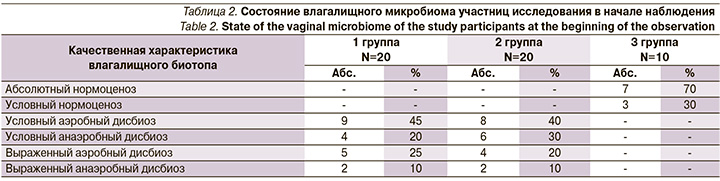
На начальном этапе эксперимента было проведено комплексное лабораторное исследование состояния влагалищного биотопа с применением тест-системы Фемофлор-16. По результатам качественной оценки состояния влагалищного биотопа, проведенной до начала клинического этапа исследования, установлено, что для пациенток с клиническими проявлениями БВ характерна картина условного аэробного, анаэробного, выраженного аэробного и анаэробного дисбиоза. В контрольной группе участниц исследования превалировали пациентки с абсолютной нормофлорой (табл. 2).
В 1 группе участниц исследования, получавщих экспериментальную схему терапии БВ (классическая схема + синбиотик Максилак©) была проведена поэтапная оценка состояния влагалищного биотопа. Установлено, что к 5-му дню проводимой антибиотикотерапии среди участниц исследования превалировали случаи условного аэробного дисбиоза и условно-анаэробного дисбиоза, зарегистрированы отдельные единичные случаи условного нормоценоза и выраженного аэробного дисбиоза (табл. 3).
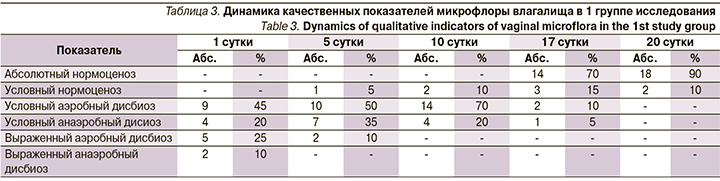
К концу этапа элиминации возбудителя в группе превалировали случаи условного нормоценоза и условно-аэробного и условно-анаэробного дисбиоза. На втором этапе терапии (прием синбиотика Максилак©), на 17 сутки, зарегистрировано превалирование случаев абсолютного и условного нормоценоза над единичными случаями условного дисбиоза. К окончанию наблюдения за пациентками (20-й день исследования) в структуре состава влагалищного биотопа пациенток регистрировались только случаи абсолютного и условного нормоценоза, что свидетельствует о качественно проведенном лечении и достижении целевых результатов.
На этапе клинического наблюдения за пациентками 2 группы, принимающих традиционную схему терапии БВ, установлено, что начальная элиминация возбудителей условно-патогенной и патогенной микрофлоры фиксировалась на 5-й день проводимого этапа антибиотикотерапии. К окончанию курса лечения в структуре группы наблюдения превалировали пациентки с состоянием условно-аэробного и условно-анаэробного дисбиоза, что обусловлено снижением доли комменсальной микрофлоры, в частности лактобактерий (табл. 4).
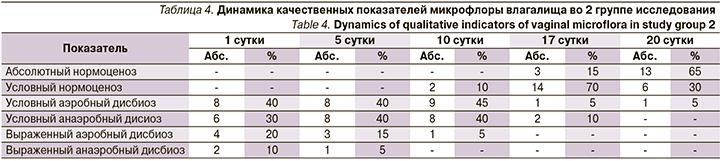
Следующим этапом терапии БВ во 2 группе следовало назначение симбиотика Максилак© в течение 10 дней. По результатам промежуточного анализа, проведенного на 17-й день наблюдения, установлено превалирование случаев условного нормоценоза, а также единичные случаи абсолютного нормоценоза. К заключительному дню наблюдения за пациентками зарегистрировано абсолютное большинство случаев абсолютного нормоценоза и единичных случаев условного нормоценоза.
Дополнительные результаты исследования
По результатам проведенного лечения БВ у женщин перименопаузального периода достигнуты результаты, сопоставимые с показателями состояния влагалищной микрофлоры (нормофлоры) в группе контроля. Прием синбиотика Максилак© в экспериментальной группе повышал эффективность элиминации патогенных и условно-патогенных возбудителей (за счет как местного, так и системного противовоспалительного и иммуностимулирующего действия), а также ускорял процесс заселения биотопа представителями нормофлоры (ацидофильные лактобактерии).
Нежелательные явления
Нежелательные явления в ходе проведения исследования зарегистрированы не были.
Обсуждение
Резюме основного результата исследования
Назначение Максилак© в комплексной терапии БВ у пациенток в период перименопаузы позволяет на всех этапах повышать эффективность проводимого лечения. Так, БАД за счет противовоспалительного и иммуномодулирующего действия, ускоряет процесс элиминации патогенных возбудителей, потенцируя эффект от антисептиков, антибиотиков и антимикотиков.
Обсуждение основного результата исследования
Разработка потенциально новых схем коррекции дисбиотических нарушений влагалищного биотопа, в условиях растущей в человеческой популяции антибиотикорезистентности, является перспективным направлением клинической медицины и фармации. Одним из препаратов, обладающих комплексным действием (иммуномодулирующее, противовоспалительное) является синбиотик Максилак©. Его включение в схемы лечения БВ позволяет достичь клинических результатов в ранние сроки.
Ограничения исследования
В настоящем исследования ограничения отсутствовали, поскольку проведенные вмешательства регламентированы клиническими протоколами Министерства здравоохранения РФ и Российского общества акушеров-гинекологов.
Заключение
Включение в схему лечения БВ у женщин в перименопаузе синбиотика Максилак© позволяет улучшать клинические эффекты терапии за счет достоверно относительно быстрой элиминации условно-патогенных и патогенных возбудителей, а также за счет раннего восстановления влагалищного биоценоза.